Assemblers
The PeripheralAssemblers are microscopic units whose capacity to move, reshape, construct, and consume matter makes them central to the built environment and conflicts of the future. They restore and remake London, but they can also dismantle objects, erase restraints, and seek biological targets; the same technology that supports everyday life therefore carries an unsettling capacity for force.
Nature and Capabilities
The term refers to units that act on material at microscopic scale, directed toward tasks set by people or institutions. In London, they can consume foreign objects, from drifting polymer to more complex materials, and are said to be continuously at work. Their action can make solid matter appear to pass through other solid matter: in Notting Hill, assemblers shifted the particles between a buried excavator and its destination, bringing the machine to the surface without simply removing the ground above it.
Their capabilities are not limited to construction or excavation. When directed as weapons, specialized assemblers seek out and disintegrate soft animal tissue. These units are self-limiting and single-purpose, then disassemble themselves; a weapon’s stated range is a little under ten meters. In one deployment, a few thousand units were expended, while millions remained in the weapon. The technology is thus presented not as a single-purpose machine but as a flexible material process whose outcomes depend on its programming, scale, and direction.
Rebuilding the Post-Jackpot City
After the Jackpot, assemblers helped reshape London. They excavated and cleaned buried rivers after the die-off, and built and maintained the towers arranged in the city’s grid of shards. This labor is described as ongoing: the city’s apparently settled architecture depends on machines continually caring for it.
Oxford Street offers a more visible example of that transformation. Ruins of department stores were cut back and turned into a long planter, with an elevated central path and trees growing through the former street. To create the greenway, assemblers carved a long cross-section through the street’s ruined buildings; the exposed cut surfaces could be slick even where the material had been brick or wood. The planted route combined the remnants of the old commercial street with a new landscape, making the technology both an instrument of reconstruction and the means by which the city’s past was physically altered.
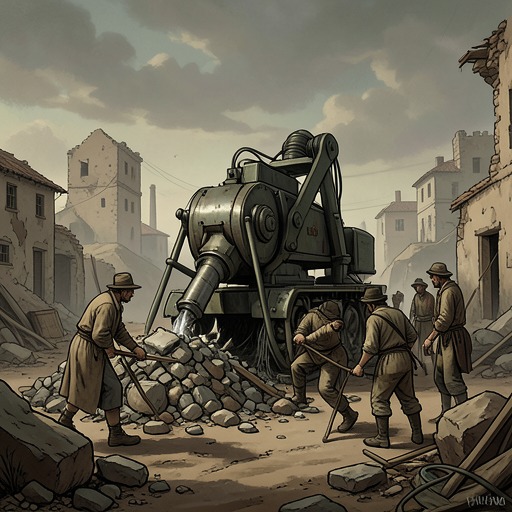
The assemblers’ work also recovers objects that earlier inhabitants had effectively buried. In a Notting Hill park, excavators abandoned beneath concrete by pre-Jackpot property owners were found, restored, and arranged in a circle, their raised blades and scoops turning them into a favorite of local children, including Lev’s. The same process that can move material through material thus returns machines to public view and gives obsolete infrastructure a second life.
Consumption and the Limits of Control
The technology can also threaten the places it has made. On the patchers’ island, assemblers were already consuming the visitors’ units, devouring what did not belong to their environment. Among the island’s figures, a dead patcher’s body had become part of the surrounding structure: its cells had been replaced with recovered polymer. The episode makes the island’s processes difficult to separate from its inhabitants and architecture; assemblers do not merely build a setting but continue to absorb and transform whatever enters it.
A weapon housed in a high-security pram demonstrates the danger of trying to handle assemblers casually. Its devices are described as antikidnapping weapons, intended to protect an infant, and their design directs units toward a biological target once the system acquires one and is triggered. When one was touched, the projected assemblers consumed much of the vehicle’s leather upholstery and part of a biological component of a manipulator. The weapon was believed to have no off switch and to remain ready to act against anyone attempting to remove it. Its initial deployment used only a small fraction of the remaining units, and the weapon could not be reloaded locally.
After considerable effort, the devices were deactivated and placed in a fitted rosewood case, their glossy cream-and-scarlet barrels making them look almost like toys. The contrast between their appearance and their function is consequential: they are not ballistic guns but directed swarm weapons, capable of rapidly disintegrating soft animal tissue and then disassembling themselves. Their handles and manual triggers had been added to meet Lowbeer’s specifications, converting a concealed defensive system into something that could be handled and presented as an object.
Assemblers in Conflict and Their Wider Significance
Assemblers are used not only to construct and maintain, but also to alter the conditions of an encounter. During an interrogation, they caused iron cuffs to crumble and brought a candy-cane gun up through the granite arm of a chair. Elsewhere, an elevator appeared in a circular wall, an operation requiring a considerable quantity of assemblers. These interventions show that their capacity to relocate or reshape material can change what people can reach, where they can move, and what means of resistance are available.
That power is not always governed by the same constraints. Netherton recalls restrictions on wholesale use of assemblers, yet the elevator’s construction appears to disregard them or proceed outside their application. The technology’s practical limits are therefore also political and institutional: who can direct large quantities, and whether rules apply, shape its consequences as much as its microscopic mechanism does.
Across these uses, assemblers blur the boundary between infrastructure and agency. They clean rivers, carve a greenway from commercial ruins, restore buried machines, consume foreign material, and become weapons aimed at living targets. Their significance lies not in a simple opposition between helpful and harmful machines, but in the way the same material power can sustain a city, remake its history, or abruptly change the balance of a confrontation.